EU regulatory guide

Banned or restricted? The EU ingredient rules.

Whether an ingredient is legal in the EU is not a matter of opinion: it is a row in an annex of Regulation 1223/2009. This page answers the most-asked ingredient questions with the actual entries, captured from EUR-Lex with the row highlighted, so you can see the rule rather than take our word for it.

Reviewed by Cassandra Maddocks, chemist & biochemist · last reviewed 26 July 2026

Is retinol banned in the EU?
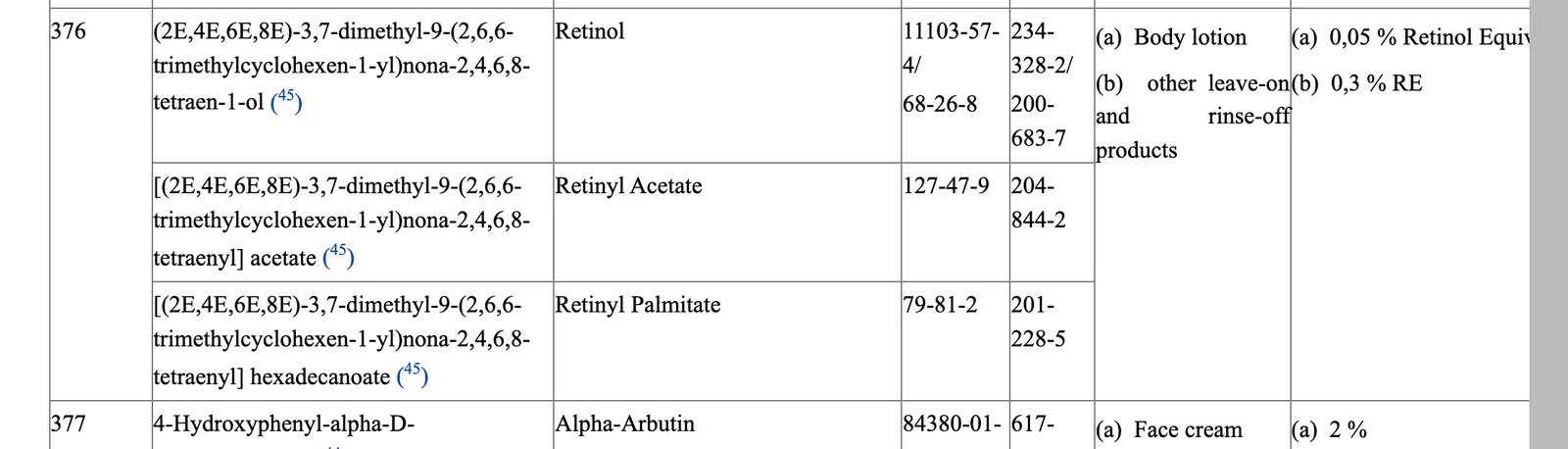
No, restricted. Annex III entry 376 caps retinol at 0.05 percent Retinol Equivalent in body lotion and 0.3 percent in other leave-on and rinse-off products, and requires the label warning: Contains Vitamin A, consider your daily intake before use.
Annex III entry 376 for retinol on EUR-Lex with the mandatory Vitamin A label warning highlighted
Annex III, entry 376: the retinol restriction with its mandatory labelling, as published on EUR-Lex, consolidation of 1 May 2026 (02009R1223, EN, 040.001). Captured 26 July 2026. View the official text.

Products formulated above the caps, common in US and Asian retinoids, cannot simply be renotified: the formula itself has to change, and the label needs the warning verbatim. The reformulation check belongs in the CPSR inputs stage, before money is spent on testing.

Is Lilial (Butylphenyl Methylpropional) banned in the EU?
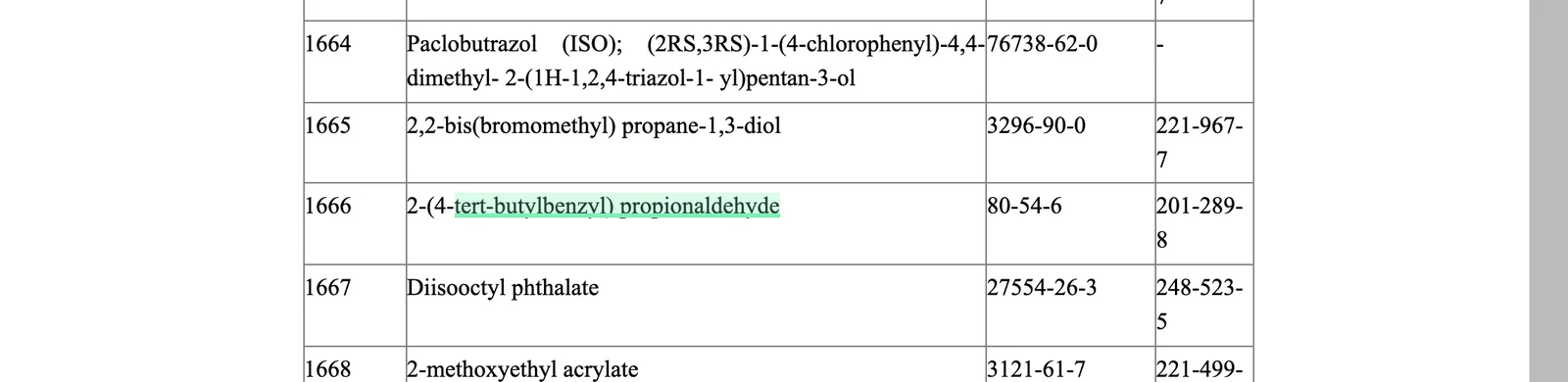
Yes. Lilial, listed under its chemical name 2-(4-tert-butylbenzyl) propionaldehyde, is entry 1666 in Annex II, the list of substances prohibited in cosmetic products. The ban followed its classification as a reprotoxic substance, and it applies at any concentration.
Annex II entry 1666 on EUR-Lex with the banned fragrance Lilial highlighted
Annex II, entry 1666: the Lilial prohibition, as published on EUR-Lex, consolidation of 1 May 2026 (02009R1223, EN, 040.001). Captured 26 July 2026. View the official text.

Lilial was one of the most used fragrance ingredients in Europe before the ban, so legacy stock and non-EU formulations still carry it. An INCI line reading Butylphenyl Methylpropional means the product cannot be placed on the EU market at all.

Is kojic acid banned in the EU?
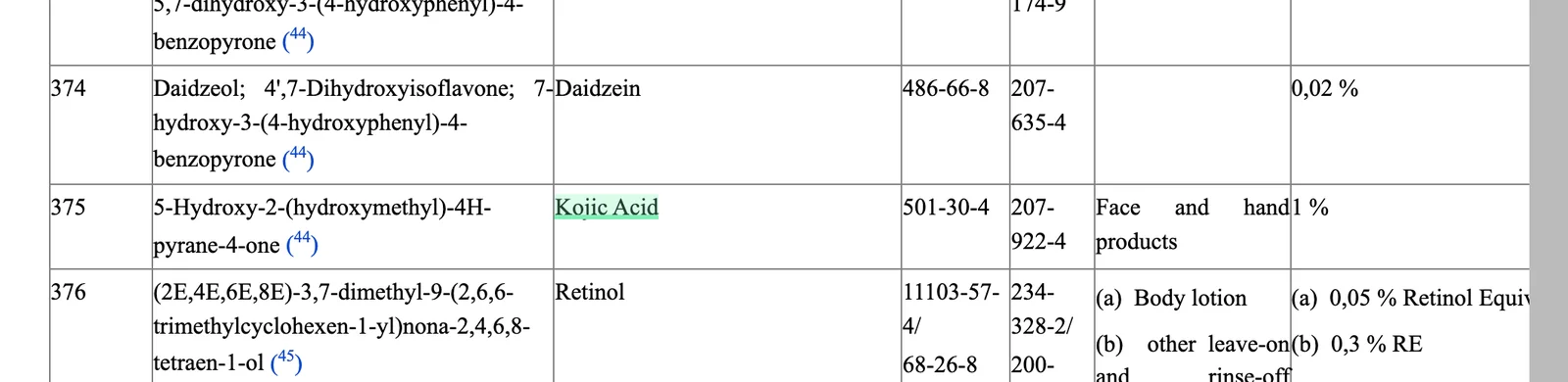
No, restricted. Annex III entry 375 allows kojic acid in face and hand products at up to 1 percent. Outside those product types, or above that concentration, a product is non-compliant even though the ingredient itself is not banned.
Annex III entry 375 for kojic acid on EUR-Lex with the 1 percent face and hand limit in frame
Annex III, entry 375: the kojic acid restriction, as published on EUR-Lex, consolidation of 1 May 2026 (02009R1223, EN, 040.001). Captured 26 July 2026. View the official text.

Kojic acid sits in many brightening formulas imported from Asia, frequently in body products or above the threshold. This is exactly the kind of entry a safety assessor checks against your formula percentages during the CPSR.

Is hydroquinone banned in the EU?
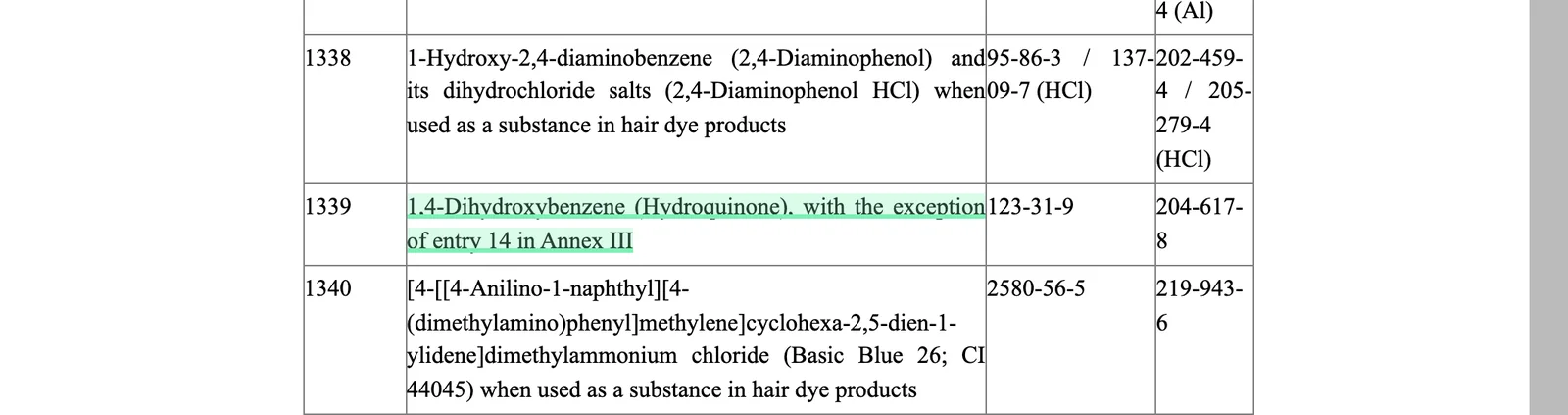
Yes, for cosmetics generally: entry 1339 of Annex II prohibits it. The single exception is professional artificial nail systems, where Annex III entry 14 allows 0.02 percent after mixing, for professional use only. Skin-lightening creams with hydroquinone are illegal on the EU market.
Annex II entry 1339 on EUR-Lex with the hydroquinone prohibition highlighted
Annex II, entry 1339: the hydroquinone prohibition and its narrow nail-systems exception, as published on EUR-Lex, consolidation of 1 May 2026 (02009R1223, EN, 040.001). Captured 26 July 2026. View the official text.

Hydroquinone remains available over the counter in other markets, which makes it a recurring seizure at EU customs and a recurring marketplace takedown. The exception is so narrow that for any skincare product the practical answer is simply banned.

Is triclosan banned in the EU?
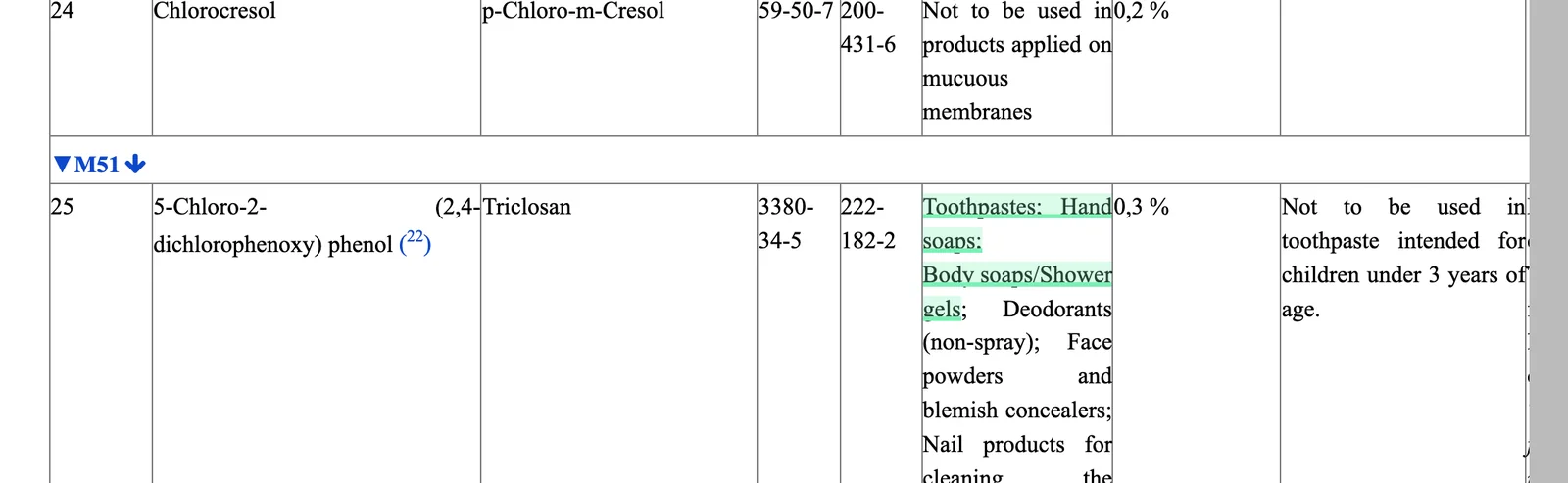
No, restricted. Annex V entry 25 permits triclosan as a preservative at up to 0.3 percent, but only in listed product types such as toothpaste, hand and body soaps, deodorants and face powders, and at 0.2 percent in mouthwash. Toothpaste with triclosan must carry a not-for-children-under-3 warning.
Annex V entry 25 for triclosan on EUR-Lex with the permitted product list highlighted
Annex V, entry 25: the triclosan preservative limits and permitted product types, as published on EUR-Lex, consolidation of 1 May 2026 (02009R1223, EN, 040.001). Captured 26 July 2026. View the official text.

The product-type list is the trap: 0.3 percent triclosan is lawful in a hand soap and unlawful in a leave-on cream at the same concentration. Preservative systems are checked line by line against Annex V during the safety assessment.

Is formaldehyde banned in the EU?
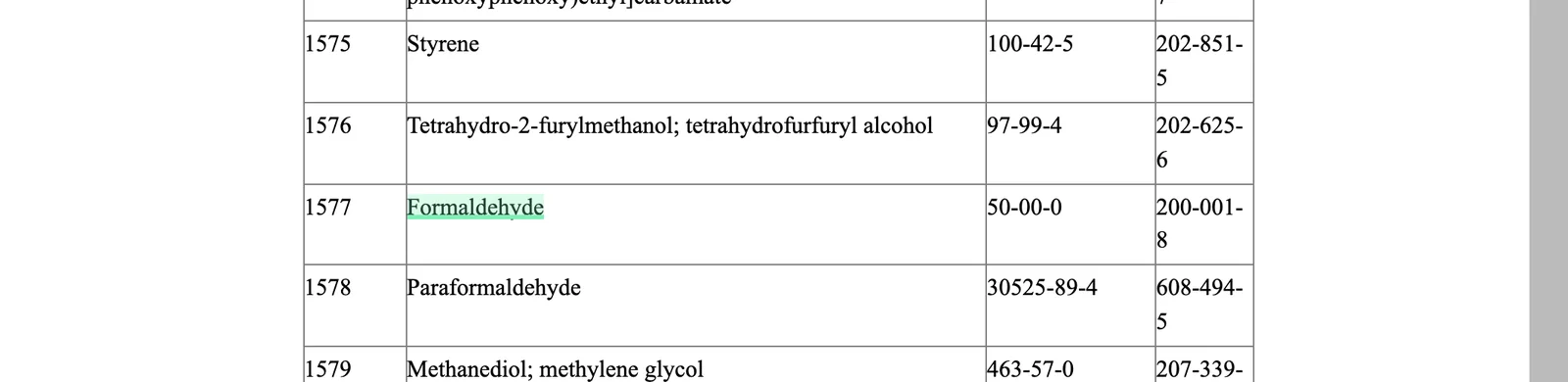
Yes. Formaldehyde is entry 1577 in Annex II and cannot be used as an ingredient. Separately, formaldehyde-releasing preservatives remain legal within their own Annex V limits but trigger a released-formaldehyde labelling threshold, so an INCI without formaldehyde does not automatically mean formaldehyde-free.
Annex II entry 1577 on EUR-Lex with the formaldehyde prohibition highlighted
Annex II, entry 1577: the formaldehyde prohibition, as published on EUR-Lex, consolidation of 1 May 2026 (02009R1223, EN, 040.001). Captured 26 July 2026. View the official text.

The releaser nuance is where brands stumble: preservatives like DMDM hydantoin are assessed on their own entries and on what they release. Our label requirements guide covers the warnings side.

How do the annexes actually work?

Annex II lists substances banned outright, more than 1,700 entries. Annex III lists restricted substances with conditions on concentration, product type and labelling. Annexes IV, V and VI are positive lists: only listed colorants, preservatives and UV filters may be used at all. A formula is checked against all of them.

This is why an ingredient list alone cannot clear a product: the same substance can be lawful in one product type and unlawful in another, and the annexes are amended several times a year. The check against the current consolidation is part of every CPSR we sign, and the captures on this page are re-validated against the live text.

Is animal testing banned in the EU?
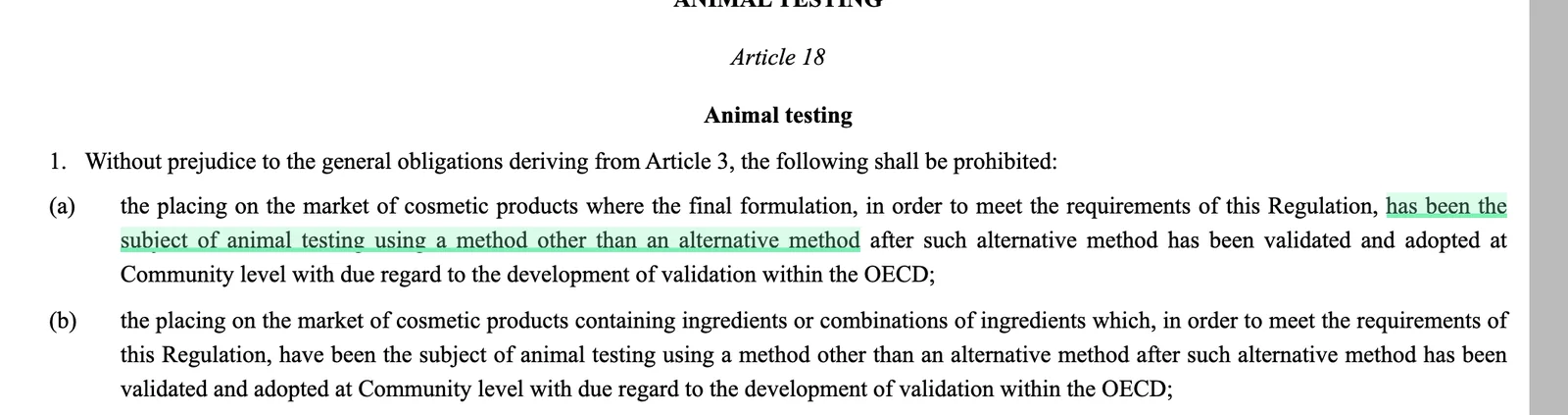
Yes, twice over. Article 18 prohibits placing cosmetics on the EU market where the final product or its ingredients were animal-tested to meet the Regulation, and it prohibits running such tests in the EU. The bans have been fully in force since 2013, with alternative methods required instead.
Article 18 of Regulation 1223/2009 on EUR-Lex with the animal testing marketing ban highlighted
Article 18, the animal testing and marketing bans, as published on EUR-Lex, consolidation of 1 May 2026 (02009R1223, EN, 040.001). Captured 26 July 2026. View the official text.

Note what the ban does not do: it does not certify cruelty-free claims, which remain marketing statements governed by the claims rules, and it does not cover testing done for non-cosmetic regimes elsewhere. A cruelty-free logo is a claim; Article 18 is the law underneath it, unpacked in our cruelty-free guide.

Sources

Primary sources cited in this guide. Annex entries verified against the 1 May 2026 consolidation on 26 July 2026; captures are re-validated against the live text.

Not sure about an ingredient?

Send us the INCI list and target products. We check every line against the current annexes as part of the CPSR, $450 to $600 per product.