Project service
Label and claims review.
Your labels and marketing claims checked against the rules in each market, before they cost you a recall or a warning.
What the law requires
Compliant labels and supportable claims.
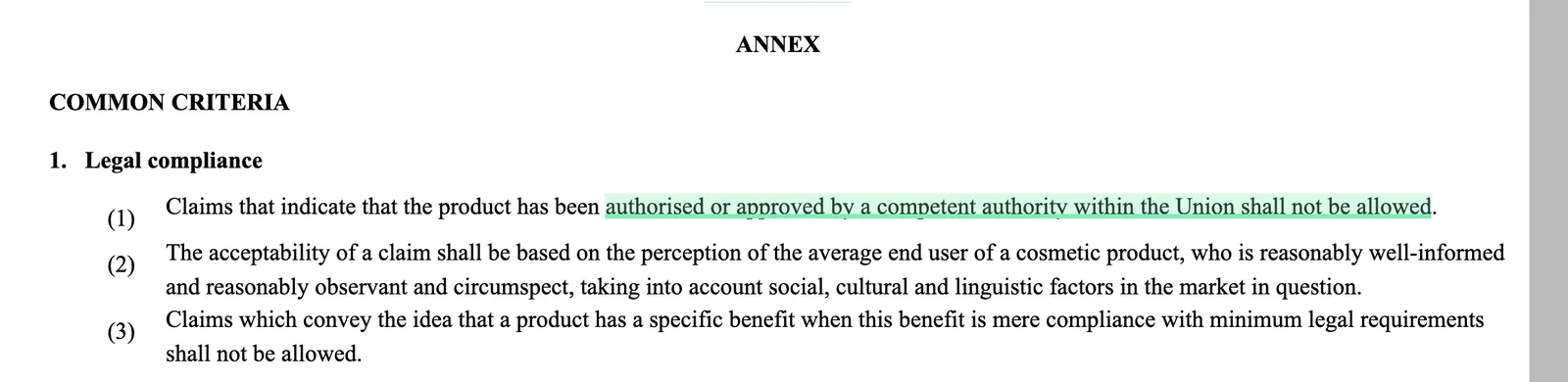
Cosmetic labels are regulated. The ingredient list must follow INCI conventions, the mandatory information must appear in the right form, and the claims you make about a product must be supportable and lawful. In the EU, claims are governed by common criteria under Article 20 of Regulation (EC) No 1223/2009, and labelling under Article 19. The UK, Switzerland and the US each set their own rules. A non-compliant label or an unsupportable claim can lead to enforcement action even when the product itself is safe.
Labelling and claims are a common cause of market-surveillance findings and recalls. Regulators and enforcement labs flag missing INCI, untranslated warnings, missing batch numbers, and claims that cannot be backed by evidence. In the EU Safety Gate, cosmetics are among the most reported product categories, and problems here can force relabelling or withdrawal after a product is already on the shelf. A review before you print catches these issues while they are still cheap to fix.
What this service is
A document review, not a safety assessment.
Three things get confused: the safety report on the product, the file behind it, and the words on the pack. This service reviews the last of the three.
Reviewed by Cassandra Maddocks, chemist & biochemist · last reviewed 26 July 2026
A label review checks your artwork against every target market's rules before print: Article 19 particulars and INCI for the EU, the UK RP address for GB, Swiss-language warnings, and the US adverse-event contact. CIG reviews labels and claims for $300 per product.
Legal basis: EUR-Lex: Regulation (EC) 1223/2009, FDA: Cosmetics Labeling, Fedlex: Swiss Cosmetics Ordinance (VKos).
The safety of the formulation is assessed in the Cosmetic Product Safety Report (CPSR) and held in the Product Information File (PIF). Those are separate services. The label and claims review looks at what a buyer, a marketplace, and a regulator actually see: the artwork, the ingredient panel, the mandatory information, and the marketing copy on the pack, the carton and the campaign. Its job is to check that the words and the panel are lawful and supportable in each market where the product will sell, before you commit them to print.
The review does not test the product, sign a CPSR, or file a notification. When a claim needs test data to stand up, we tell you which claim and what evidence would support it, so you can decide whether to soften the wording or commission the study. The CPSR and the notification are handled under their own services, and the label check fits alongside both.
How CIG covers it
What is included.
A review of your ingredient panel, mandatory information and claims, with clear findings you can act on before launch.
We review your ingredient panel against INCI conventions, checking naming, order, and the way concentrations and allergens are handled.
We check your mandatory label information for each target market: the responsible person or contact address, the batch number, the period after opening or best-before date, net quantity, function, and any required warnings.
We check warnings and language. Some markets require warnings and instructions to appear in specific official languages before a product can be sold.
We assess your marketing claims against the rules that apply where you sell, and we flag any claim that would reclassify the product or that needs evidence to stand up.
We flag what needs to change and explain why, in plain terms, so you can fix issues before you print or go live.
The whole packaging surface is in scope: the ingredient panel, the outer carton, any leaflet, and the marketing copy that travels with the product on your own site and on the marketplaces. If you sell across several markets, we tell you where one label can serve more than one market and where a market needs its own wording, so you are not printing more versions than you need.
What you receive: your review report
The report is written to be handed straight to your designer or copywriter. You do not need to read the regulation to act on it. Where a fix changes how the product is classified, for example a claim that would push a cosmetic into drug territory, we say so directly so the decision sits with you before anything reaches a printer or a marketplace listing.
By market
What changes from one market to the next.
A label that is compliant in one market is not automatically compliant in another. We review against the specific rules where you sell.
European Union
Labelling follows Article 19 of Reg. 1223/2009 and claims follow the common criteria under Article 20. The label must show the responsible person's name and address, the ingredient list in INCI, net quantity, a batch number, a best-before date or period after opening, function, and any required warnings. Products with nanomaterials must name them in the ingredient list and carry a separate Article 16 notification.
United Kingdom
Great Britain runs its own version of the regulation. The label must carry a UK responsible person's name and address, which is separate from the EU one, so a product sold in both markets can need two addresses across its label versions. Northern Ireland follows the EU rules under the Windsor Framework, so an EU responsible person and EU labelling apply there rather than the GB route.
Switzerland
Warnings and instructions must appear in at least one official Swiss language: German, French or Italian. Claim approvals from the EU or UK do not carry over automatically, so compliant EU packaging is not automatically compliant for the Swiss shelf. We check the panel and warnings against Swiss requirements and flag where a translation or a wording change is needed.
US (MoCRA)
The label must carry a US contact for adverse-event reporting. The bigger trap is claims: drug claims such as "treats eczema", "reduces inflammation" or "repairs the skin barrier" reclassify a product as an over-the-counter drug, out of the cosmetic rules and into stricter ones, and have drawn FDA warning letters. We flag claims that would push your product across that line.
Who does the work
Reviewed by regulatory specialists.
The review is carried out by regulatory specialists who work across the EU, UK, Switzerland and US rules every day. Where a claim depends on the safety profile of the formulation, the same qualified safety assessor who signs cosmetic safety reports can be consulted, so a claim question is answered against the science rather than guessed at.
This service is a review of your labels and claims. It does not produce or sign a safety report. If your product also needs a CPSR, that is assessed and signed under the safety assessment service by a qualified assessor holding a recognised diploma in pharmacy, toxicology or medicine.
What we need from you
The inputs for a review.
The more of this you can send, the more complete the review. Missing items are noted rather than guessed.
The full formulation or INCI list, ideally with concentrations, so allergens and any restricted ingredients can be checked in context.
Your label and packaging artwork, as print-ready files or clear proofs, including the outer carton and any leaflet.
Your marketing claims, both the on-pack copy and the wording planned for your website and marketplace listings.
The target markets, so we review against the right rules and flag where one label can serve more than one market.
Any test data behind a claim, such as an efficacy or SPF study, if you already hold it.
Timeline
How long it takes.
A label and claims review is one of the faster steps in getting to market. The right time to run it is before you send artwork to print.
Turnaround depends on how many products and markets are in scope and on how complete your files are when you send them. A single product for one market with clean artwork and a clear claim set is quick. A range across several markets, or a product with heavy efficacy claims, takes longer because each claim is checked against the rules where it will run. We confirm a turnaround with your fixed quote, so you know the timing before the work starts.
Run the review early. Catching a labelling or claims problem before print costs a wording change. Catching it after a launch can mean a reprint, a relabelling run, or a withdrawal, and it can hold up a marketplace listing that will not go live until the label is right.
Edge cases
Products that need more care.
Some products carry extra labelling or claims rules. We flag these so nothing is missed before you go to print.
Nanomaterials
Ingredients used as nanomaterials must be named as such in the EU ingredient list, and the product needs a separate Article 16 notification on top of the standard route. We flag the labelling side and point you to the notification service for the filing.
Baby and child products
Products for babies and children sit in a higher-scope category, with tighter expectations on warnings, instructions and claims. We review the panel and claims against that higher bar.
Sun and efficacy claims
SPF, water resistance, anti-ageing and similar claims usually need test data to stand up. We flag which claims need evidence and what kind, so you can decide whether to soften the wording or commission a study.
Drug-territory claims
Wording that describes treating, healing or altering a body function can reclassify a cosmetic as a drug, which carries a different and stricter rulebook. We flag any claim that crosses that line before it reaches a label or a listing.
Who it is for
Brands finalising packaging and marketing.
If you are preparing artwork, packaging or campaign copy for a new market, a label or claims problem can lead to enforcement action even when the product is safe. This service suits brands that want their labels and claims checked against the rules of each market before they commit to print or go live.
It is a common step when a brand that already sells in one market opens a second one, since the label that passed at home may need changes for the new market. It also fits brands moving from a marketplace warning back to a compliant listing, and brands rewriting campaign copy that leans harder on claims than the evidence supports.
Pricing
Fixed, transparent pricing.
A label and claims review per product, at a single published rate.
Prices in USD, per product.
See full pricing →Where this service fits
Label review in your compliance path.
FAQ
Common questions.
Related
Pairs well with.
Notifications
Get label and ingredient details right before they reach a portal.
View service →Safety assessment (CPSR)
The mandatory safety report for the product itself.
View service →Compliance Care
Label and claims updates kept current as the rules shift.
View service →Sell in the EU
The full picture of what the EU market requires.
EU market →In practice
Compliance, in the real world.