Project service
Product Information File (PIF) compilation.
The technical dossier every cosmetic on the EU, UK and Swiss markets must have, compiled and kept current.
What the law requires
A complete technical dossier the Responsible Person holds.
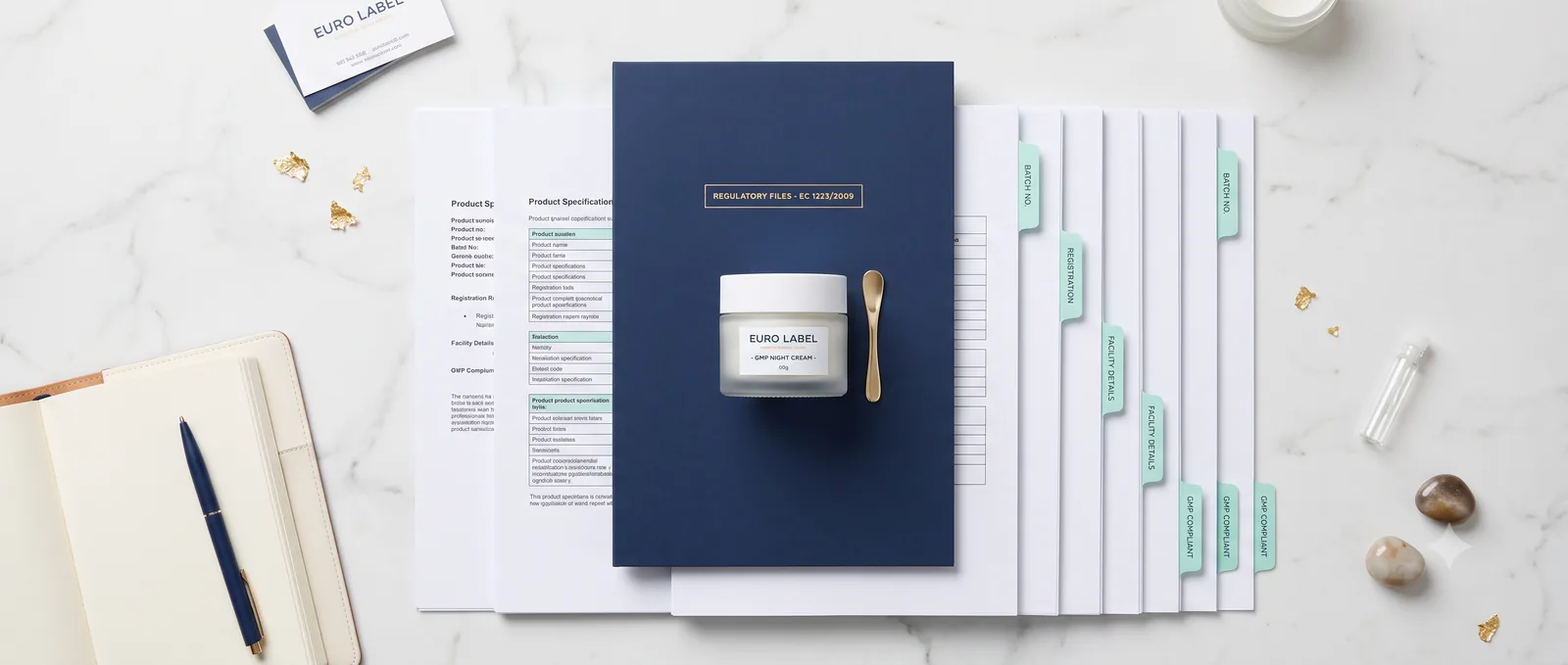
Every cosmetic product placed on the EU, UK or Swiss market must have a Product Information File. The PIF is the complete technical dossier for the product. It must be held by the Responsible Person at the address printed on the label, kept up to date, and made available to a competent authority on request. In the EU the file is defined by Article 11 of Regulation (EC) No 1223/2009, and it must be kept for ten years after the last batch of the product was placed on the market. The UK Cosmetics Regulation carries the same ten-year rule, and Switzerland requires the file to be retained for ten years from the date the last batch was first placed on the market.
An incomplete or missing PIF is one of the most common reasons a first-time brand is asked to relabel or withdraw a product. When market surveillance contacts the Responsible Person, the file is what has to be produced, and it has to be produced quickly. A file that is complete, current and structured to the regulation removes that risk.
How the pieces fit
PIF, CPSR and the safety assessment are not the same thing.
These three terms are often used as if they were interchangeable. They sit inside one another, and getting the relationship right is what keeps a dossier defensible. Our comparison guide puts all three side by side.
Reviewed by Cassandra Maddocks, chemist & biochemist · last reviewed 26 July 2026
The Product Information File is the complete dossier Article 11 requires for every EU cosmetic: product description, the signed CPSR, GMP evidence, claims support and animal-testing data, kept ten years at the Responsible Person's address. CIG assembles it, keeps it current and produces it on inspection.
Legal basis: EUR-Lex: Regulation (EC) 1223/2009, ISO 22716.
The safety assessment
The technical judgement of whether the product is safe for human health under normal and reasonably foreseeable use. It weighs the toxicological profile of every ingredient, the exposure, and the Margin of Safety, and it is signed by a qualified assessor.
The CPSR
The written safety report that records that assessment. Its Part A gathers the safety information (composition, stability, microbiological quality, impurities, exposure, toxicological profile). Its Part B is the assessor's conclusion, warnings, reasoning and signature.
The PIF
The full file that holds the CPSR alongside the product description, the manufacturing method and GMP statement, proof of claims, and animal-testing data. The PIF is the container. The CPSR is one part of it.
A product needs all three, and the PIF is what the Responsible Person is asked to produce when an authority comes calling.
How CIG covers it
What is included.
A full file built to the structure each market requires, then kept complete as your formula, labelling or the regulations change.
We compile your full Product Information File to the Article 11 structure, in the format the EU, UK or Swiss market requires.
We include your signed safety report as Part A and Part B of the file, so the dossier is complete on the day it is handed over.
We assemble the supporting records around it: the product description, the manufacturing method with the GMP statement, proof for any claim that needs it, and the animal-testing data.
We hold it and keep it available so the Responsible Person can produce it for a competent authority on request, in the language the market accepts.
We update it when your formula, packaging, labelling or claims change, or when the regulation moves, so the file on record matches the product on the shelf.
What we need from you
The inputs that let us build the file.
A PIF is only as good as the source records behind it. Most of what we ask for is material you already hold or can get from your manufacturer. Where something is missing, we will tell you plainly what has to be produced before the file can be completed, so there are no surprises late in the process.
If you do not yet have a safety report, we can produce and sign the CPSR as part of the same piece of work, then build the file around it. If you already hold a valid, correctly signed report, we can compile the file around your existing document.
Timeline
How long a file takes.
Compiling the file is fast once the inputs are in. The part that takes real time sits upstream, in laboratory testing, and it is worth planning for early.
When your records are complete, we compile the file promptly and hand it over ready for the Responsible Person to hold.
If the CPSR is part of the work, the safety assessment step runs first, then the file is assembled around the signed report.
Laboratory testing is the long pole. Stability testing alone commonly runs three to twelve months for a new formulation, and challenge testing and microbiological work take their own time. A brand that starts the file late because testing was booked late will miss its launch window, so we flag any gaps at the start.
For a new EU product, notification on CPNP can only follow once the PIF and CPSR are in place, so building the file early keeps the launch on schedule.
Edge cases
Products that need a wider scope.
Some products carry a heavier documentation and testing burden. If yours falls into one of these, the file and the safety report behind it need to reflect it.
Nanomaterials
An EU product that contains a nanomaterial requires a separate notification to the Commission under Article 16 of Reg. 1223/2009, six months before it is placed on the market, in addition to the standard CPNP notification. The file has to record the nanomaterial and its safety data.
Baby and child products
Products intended for children, and for the under-threes in particular, are assessed to a higher standard because exposure and skin sensitivity differ. The safety reasoning inside the file has to account for that, and the assessment is more involved.
Higher-scope categories
Sunscreens, hair dyes and permanent-wave products, and products making a stronger claim, tend to need more substantiation and more testing behind the file. The claim data has to be strong enough to hold under Article 19 labelling scrutiny.
Product variants
A shade, scent or size variant is a separate product for the file. Where variants share a base formula, much of the underlying work carries across, but each variant still needs its own complete dossier and its own notification.
Who it is for
Any product sold in the EU, UK or Switzerland.
Every cosmetic on these markets must have a Product Information File held by its Responsible Person. There is no small-business exemption and no turnover threshold. A hobbyist selling a few bars of soap carries the same PIF obligation as a large brand, which is why the fixed cost of getting the file right matters most to the smallest sellers.
This service suits brands that need a complete, audit-ready dossier for a product, either as a standalone deliverable or bundled with the safety report and notification in a launch pack. It also suits brands moving to CIG from another provider who want the file rebuilt or brought current before an inspection or a marketplace check.
Pricing
Fixed, transparent pricing.
A Product Information File per product, or bundled with the safety report and notification in the launch pack.
Prices in USD, per product.
See full pricing →Where this service fits
The Product Information File in your compliance path.
FAQ
Common questions.
Related
Pairs well with.
Safety assessment (CPSR)
The signed report that forms part of the file.
View service →EU Responsible Person
The mandate that holds and maintains your file in the EU.
View service →Swiss agent
Holds your file for the ten-year Swiss retention period.
View service →Sell in the EU
The full picture of what the EU market requires.
EU market →In practice
Compliance, in the real world.