Switzerland regulatory guide
How to sell cosmetics in Switzerland.
A practical guide to Swiss cosmetics requirements: the Swiss-address responsible person, the ten-year file, and why EU compliance does not carry across.
Reviewed by Cassandra Maddocks, chemist & biochemist · last reviewed 5 July 2026
Switzerland is a major beauty market that sits outside the European Union, and that single fact shapes everything about selling cosmetics there. Swiss requirements are aligned with European standards in substance, so a product built for the EU is usually close to compliant on formulation. The system is administered separately, though, and EU compliance does not carry across the Swiss border on its own. An EU Responsible Person does not cover Switzerland, an EU notification does nothing for the Swiss market, and there is no Swiss portal to notify to at all. This guide sets out what selling in Switzerland actually requires: the legal framework, who has to hold the file, the ten-year retention rule, how the post-market inspection model works, the labelling and language rules, the ways Switzerland diverges from the EU (mapped side by side in our EU vs Switzerland comparison), and the mistakes that cause problems at a cantonal inspection.
- A responsible person or agent with an address on Swiss territory.
- A Product Information File kept for ten years after the last batch.
- A safety assessment to European standard, signed by a qualified assessor.
- Labelling and warnings in at least one official Swiss language.
- A self-monitoring dossier ready for unannounced cantonal inspection.
- Cover that exists in its own right, separate from the EU.
One thing is worth stating at the outset, because it is where most brands lose time and money. Switzerland is not in the EU, and the two systems do not talk to each other. Swiss authorities have no access to the EU CPNP database, and the EU address printed on your packaging carries no legal weight in Switzerland. If you already sell in the EU, the good news is that much of the underlying technical work, formulation, testing and the safety assessment, can be reused. The Swiss obligations still have to be met in their own right: a Swiss-domiciled point of accountability, a file held to the Swiss standard, and labelling that meets Swiss language rules.
The legal framework: how Switzerland regulates cosmetics
Swiss cosmetics sit under the Federal Act on Foodstuffs and Utility Articles (817.0) and the Ordinance on Foodstuffs and Utility Articles (ODAlOUs). The specific instrument for cosmetics is the Ordinance on Cosmetic Products (817.023.31). Article 54 of the framework requires cosmetics to comply with the annexes of EU Regulation (EC) No 1223/2009, meaning the lists of prohibited substances, restricted substances, permitted colourants, preservatives and UV filters apply in Switzerland as they do in the EU. This is why a formulation that is compliant in the EU is usually compliant in Switzerland on the ingredient side. The alignment is on the substance annexes, not on the administrative machinery, which is entirely Swiss.
A second route into the Swiss market runs through the Cassis de Dijon principle. A cosmetic product lawfully placed on the market in the EU or the EEA can generally be sold in Switzerland without reformulation, provided it still meets the supplementary Swiss requirements and is not on the published Swiss negative list. This helps with the product itself, but it does not remove the need for a Swiss responsible person, a Swiss-standard file, or Swiss-compliant labelling. Cassis de Dijon addresses whether the goods may enter, not who is accountable for them once they are on the shelf.
A responsible person with a Swiss address
To place cosmetics on the Swiss market, there must be a responsible person with an address on Swiss territory. This role can be filled by a Swiss-based manufacturer, a Swiss importer, or an authorised representative appointed in writing. For a brand with no establishment in Switzerland, the practical route is to appoint a Swiss agent to take on the role, in the same way a non-EU brand appoints an EU Responsible Person. The obligation cannot be delegated to anyone located abroad, and it cannot be transferred to an EU Responsible Person. The Swiss-address requirement is the point of the rule: the authorities need a contactable party inside the country.
The Swiss meaning of the term differs from the EU meaning, and the difference matters. In Switzerland the responsible person is the contact point for the surveillance authorities and must be a physical person who can be reached during an inspection. If a company places cosmetics on the Swiss market and does not designate anyone, the role does not simply go unfilled. It falls by default to the company's chief executive, or the equivalent legal representative, who then carries personal responsibility for the products. Appointing a Swiss agent replaces that default with a named, prepared contact. CIG can act as your Swiss agent, from a base in Switzerland.
No notification portal: the self-monitoring model
Switzerland has no pre-market notification. There is no Swiss equivalent of the EU CPNP or the UK SCPN, and nothing to file before a product goes on sale. Brands sometimes read this as good news, and in one sense it removes a step. What replaces it is stricter in practice. Instead of a central database, Switzerland relies on post-market control carried out by cantonal laboratories across the 26 cantons. These labs run inspections and can request a brand's compliance data at any time, often without advance warning. The obligation is one of self-monitoring: the responsible person has to keep a complete, current dossier and be able to produce it on request. The duty has its own deep dive in our self-monitoring guide.
In effect, the burden shifts from a one-off notification to permanent readiness. There is no confirmation email to file away and forget. The product's documentation has to be inspection-ready for the whole time it is on the market. This is why a Swiss-domiciled responsible person is more than an address on a label: they are the party who receives the inspection request and hands over the file. A brand relying on an importer holds that file at one remove, which becomes a problem if the importer relationship changes.
The Product Information File, kept for ten years
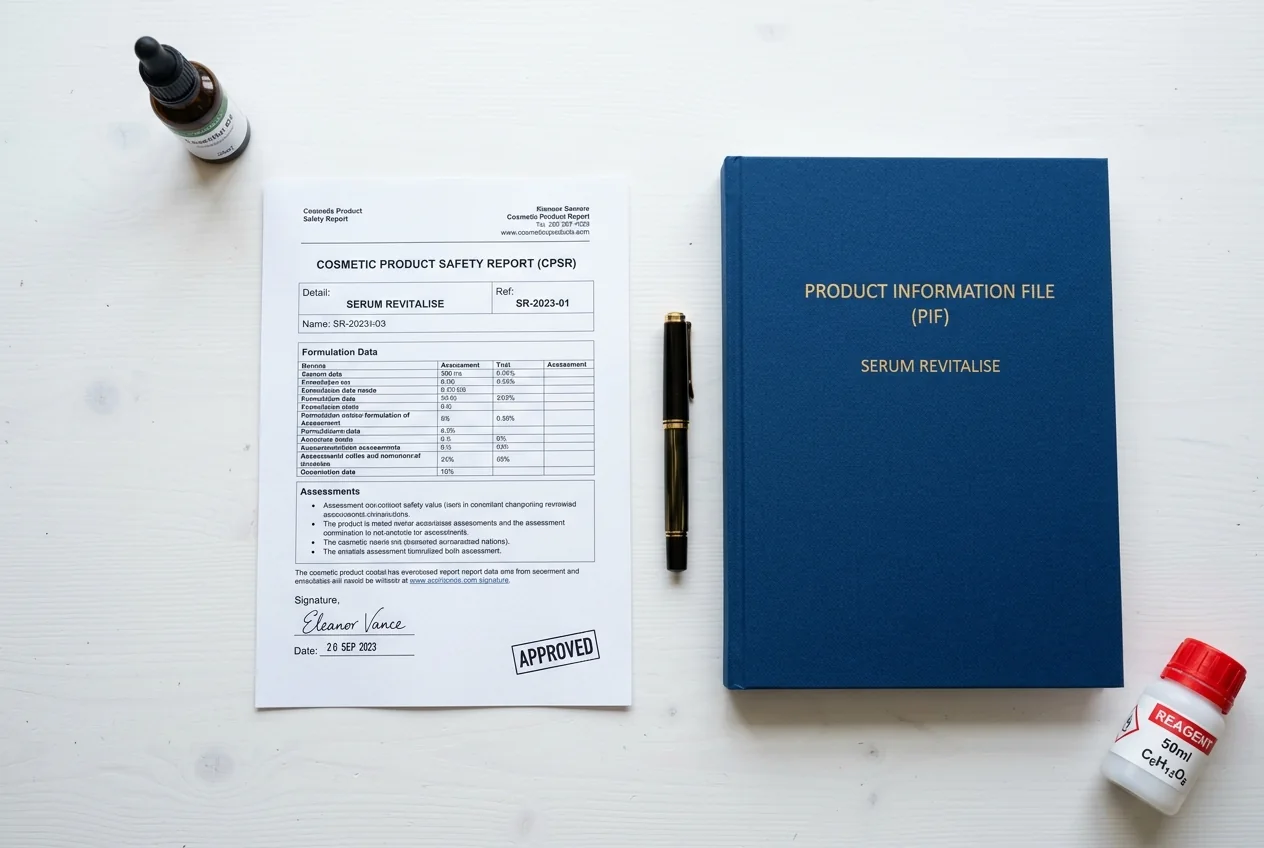
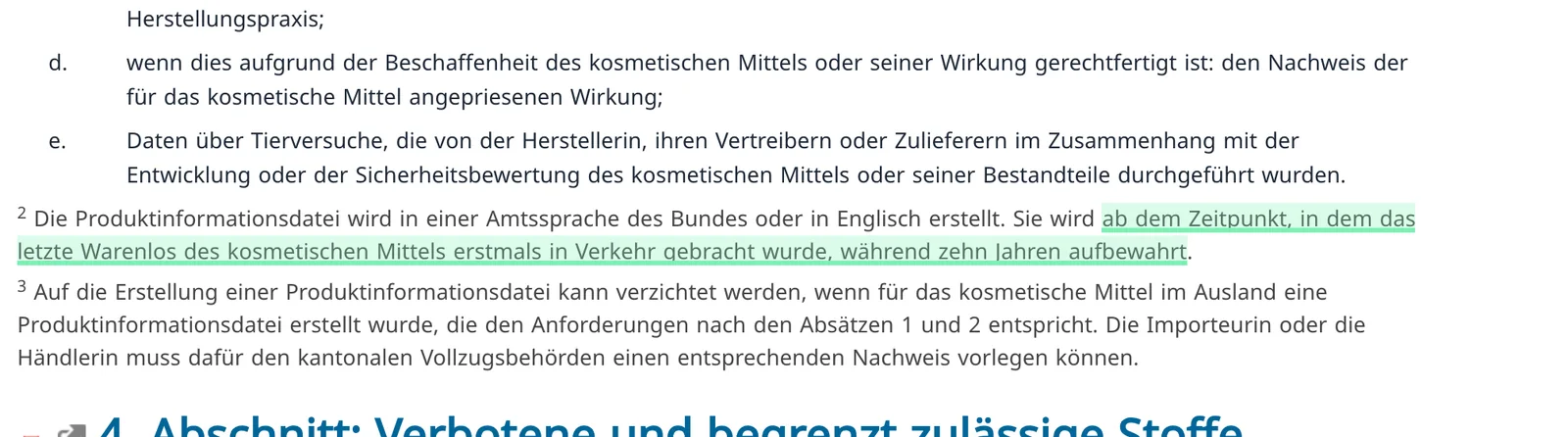
A Product Information File must be held for each product and kept available to the authorities. Switzerland sets a specific retention period: the file must be kept for ten years from the date the last batch was first placed on the market. That clock runs from the last batch, not from the launch date, so the documentation has to be maintained well beyond a product's active selling life. The contents mirror the European PIF, covering the product description, the safety assessment, the manufacturing method with a good manufacturing practice statement, evidence for any claims, and the related safety records.
An existing file compiled abroad can save real work. A PIF prepared for the EU can satisfy the Swiss requirement, provided it complies with the Swiss cosmetics and labelling rules. It may be written in an official Swiss language or in English, which means a brand does not usually have to translate the technical dossier itself, only meet the language rules that apply to the consumer-facing label. The one date brands should note is that the Swiss transition period for compliant PIF drafting and good manufacturing practice ended on 30 April 2021, so the current standard has applied for some years and is not a grace period a new entrant can lean on. See our Product Information File service for how this is assembled and kept current.
Safety assessment and the qualified assessor
Because Article 54 pulls the EU annexes into Swiss law, the safety expectations align with the European standard. A product's safety assessment is prepared and signed by a qualified assessor, someone holding a university qualification in pharmacy, toxicology, medicine or a similar recognised discipline, in the same form the EU CPSR requires. A brand already selling in the EU can generally reuse the underlying safety work rather than commission a separate Swiss study, which is one of the main efficiencies of running the two markets together. The assessment still has to reflect the product as sold in Switzerland, including any Swiss-specific labelling or warnings. Our safety assessment (CPSR) service is signed by a qualified assessor in every case, priced at $450 to $600 per product.
Labelling and language
Labelling is where Switzerland asks for something the EU does not, and it is a common reason EU-ready packaging is not automatically Swiss-ready. Warnings and instructions for use must appear in at least one official Swiss language: German, French or Italian. In practice, many brands cover more than one to reach the whole domestic market, but at least one is mandatory. This is separate from the ingredient list, which is given in INCI form as elsewhere. Beyond language, the label carries the usual mandatory information and the name and address of the responsible person, and product claims have to be truthful and supportable. EU or UK claim approvals do not carry over automatically, so a claim cleared for another market still has to hold up under the Swiss rules. Our label and claims review checks the label and the claims before you print, at $300 per product.
Where Switzerland diverges from the EU
The ingredient annexes are shared, but Switzerland is not a carbon copy of the EU, and a few divergences catch brands out. Switzerland regulates chemicals under its own Chemical Risk Reduction Ordinance (ORRChem) rather than the EU REACH regime, so obligations that flow from REACH do not map one-to-one. Switzerland imposes an incentive fee on certain volatile organic compounds, which can apply to products above a set VOC content and has no direct EU equivalent, so a product with a high volatile-solvent content may carry a cost in Switzerland that it does not carry in the EU. Switzerland also prohibits furocoumarins at a concentration of 1 milligram per kilogram or above in products intended for sun exposure, a specific limit worth checking for suntan and after-sun ranges. None of these change the core setup, but each is a reason to treat the Swiss file as its own piece of work rather than a copy of the EU one.
Why EU compliance does not transfer
This is the point brands most often get wrong, so it is worth stating plainly. Because Switzerland is not in the EU, an EU Responsible Person and an EU CPNP notification do not satisfy the Swiss requirement. The two sets of obligations run in parallel: a brand selling in both the EU and Switzerland needs cover in each, held by parties established in each. The EU address may be printed on the pack, but the Swiss compliance obligation cannot be transferred to it or to anyone abroad. The two markets do pair well, because the formulation, the testing and the safety assessment can largely be shared, and running them together avoids duplicating that technical work. The Swiss responsible-person role and the Swiss file remain separate and must exist in their own right.
Step by step: placing a product on the Swiss market
- 1Appoint a responsible person with an address on Swiss territory, or confirm which Swiss-based party (manufacturer, importer or agent) holds the role.
- 2Confirm the formulation against the EU annexes that Article 54 makes binding, and check the Swiss-specific points: ORRChem, the VOC fee where relevant, and the furocoumarin limit for sun-exposure products.
- 3Assemble the Product Information File, reusing an EU file where one exists, so it meets the Swiss standard and holds the signed safety assessment.
- 4Have a qualified assessor sign the safety assessment covering the product as it will be sold in Switzerland.
- 5Prepare labelling with warnings and instructions in at least one official Swiss language, and check the claims against the Swiss rules.
- 6Keep the self-monitoring dossier current and inspection-ready, and retain the file for ten years after the last batch.
The mistakes that cause problems in Switzerland
Most Swiss problems come from treating the market as an extension of the EU. Relying on an EU Responsible Person leaves no Swiss-domiciled contact, which means the CEO becomes the responsible person by default without realising it. Assuming an EU notification covers Switzerland leads brands to skip the Swiss setup entirely, then scramble when a canton asks for the file. Packaging that carries only English or a non-Swiss language misses the requirement for German, French or Italian warnings. Leaving the file with an importer means losing control of it if the importer changes. And overlooking the Swiss-specific divergences, the VOC fee or the furocoumarin limit, can turn a product that is fine in the EU into one that is not fine in Switzerland. Each of these is avoidable with a Swiss responsible person and a file kept to the Swiss standard.
What this means in practice
To sell a product in Switzerland a brand needs a responsible person with a Swiss-territory address, a Product Information File kept for ten years after the last batch, a safety assessment to European standard signed by a qualified assessor, labelling in at least one official Swiss language, and a self-monitoring dossier ready for cantonal inspection. For brands already entering the EU, the efficient route is to handle Switzerland alongside it, sharing the technical work while keeping the Swiss cover distinct, with a partner that can act as the Swiss agent and keep the Swiss file maintained for the full retention period. That is the role CIG plays, from a base in Switzerland. For a market-level overview, see selling in Switzerland.
Primary sources cited in this guide. Regulatory status last verified 5 July 2026.
Put this into practice
From reading to selling in Switzerland.
Switzerland questions, answered
Frequently asked questions.
In practice
Compliance, in the real world.